
Decks
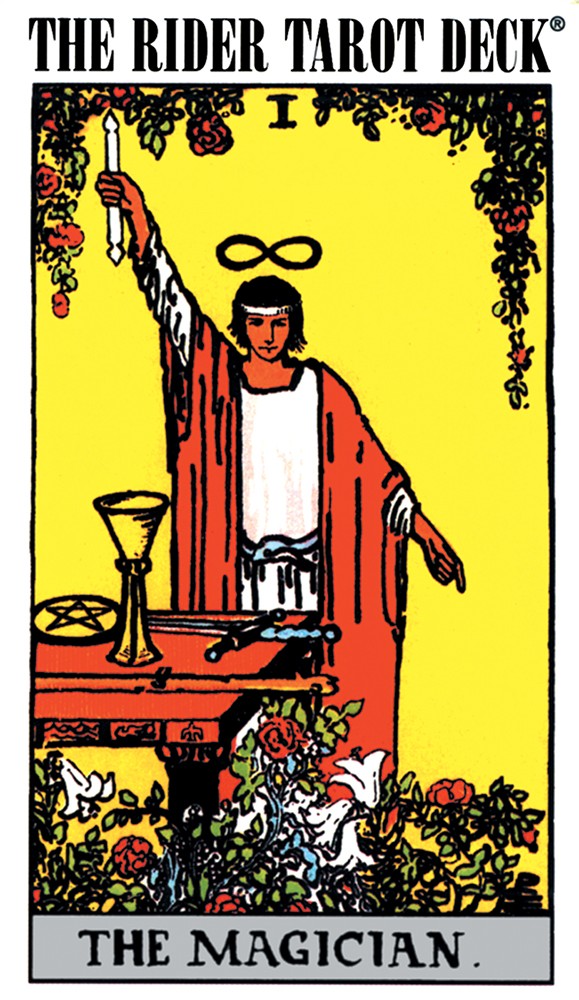
Rider-Waite-Smith
The Rider-Waite-Smith (RWS) Tarot, created in 1909 by occultist Arthur Edward Waite and illustrated by Pamela Colman Smith, was published in London by William Rider & Son. Grounded in the esoteric tradition of the Hermetic Order of the Golden Dawn, the deck revolutionized modern tarot by featuring fully illustrated scenic pips for all 56 Minor Arcana cards and transposing Strength to VIII and Justice to XI to match astrological correspondences.
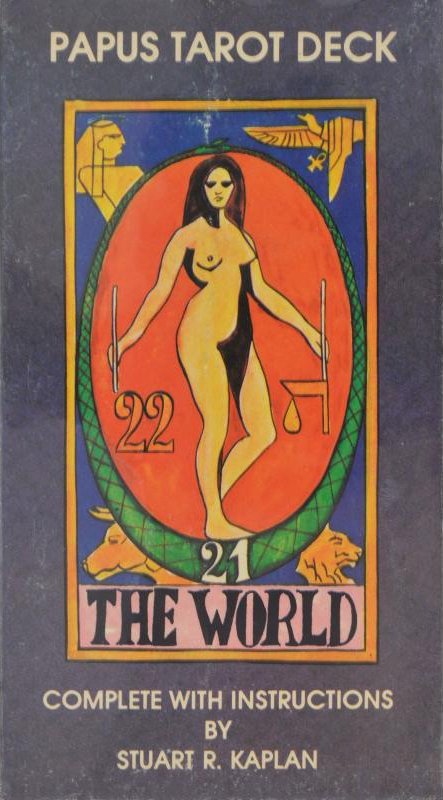
Papus
The Papus Tarot deck, designed by French occultist Gérard Encausse (Papus) with illustrations by Gabriel Goulinat, originated in his 1889 treatise Le Tarot des Bohémiens and was published as a complete deck in Le Tarot Divinatoire (1909). Rooted in the 19th-century French esoteric tradition, the cards integrate Kabbalistic Hebrew letters, astrological correspondences, Egyptian iconography, and Sanskrit symbolism while maintaining the traditional Marseille numbering order with Justice at VIII and Strength at XI.
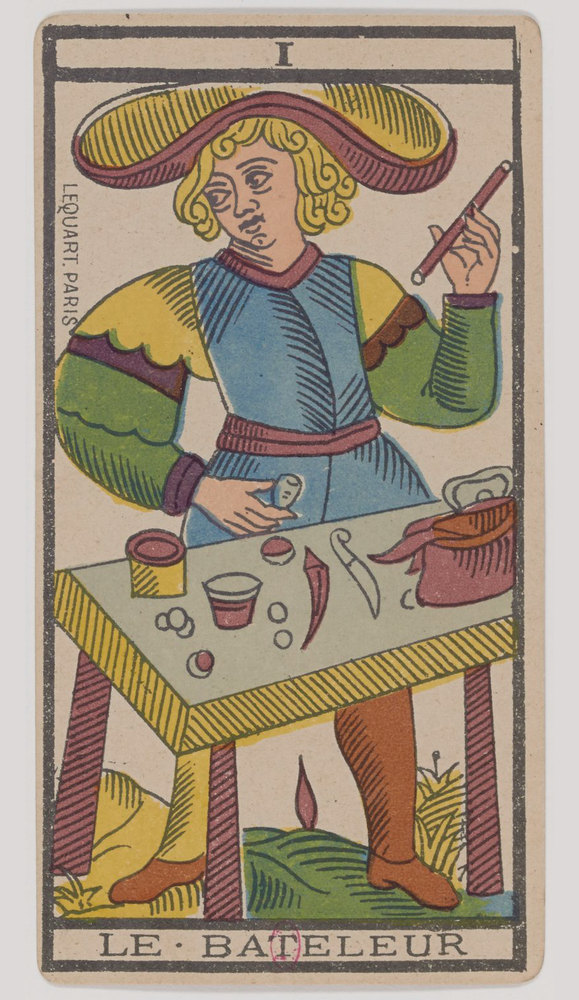
Tarot de Besançon (Lequart, 1890)
A Tarot de Besançon printed by Lequart in Paris around 1890. The Besançon pattern replaces the Popess and the Pope with Juno and Jupiter at II and V, and keeps the Marseille order, where Justice is VIII and Strength is XI — the reverse of Rider-Waite-Smith. Scans from Wikimedia Commons, public domain.
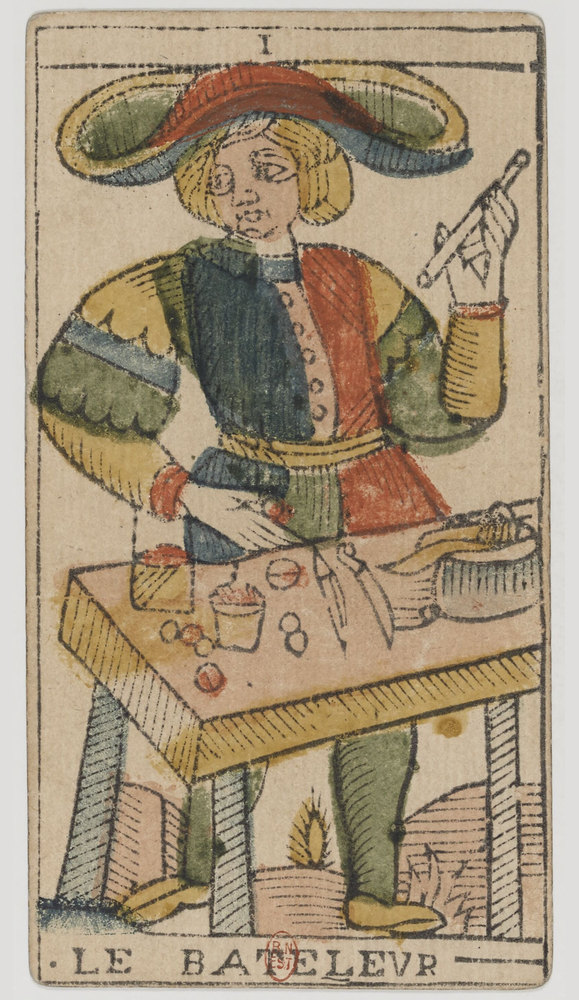
Tarot de Marseille (Dodal, Lyon, c. 1701)
A Tarot de Marseille cut by Jean Dodal in Lyon between 1701 and 1715, and one of the oldest complete Marseille packs to survive. It was printed for export — several cards carry the legend F·P·LE·TRENGE, faict pour l'estranger — and keeps the Popess at II and the Pope at V, with the Marseille order in which Justice is VIII and Strength is XI, the reverse of Rider-Waite-Smith. Scans from the Bibliothèque nationale de France via Wikimedia Commons, public domain.
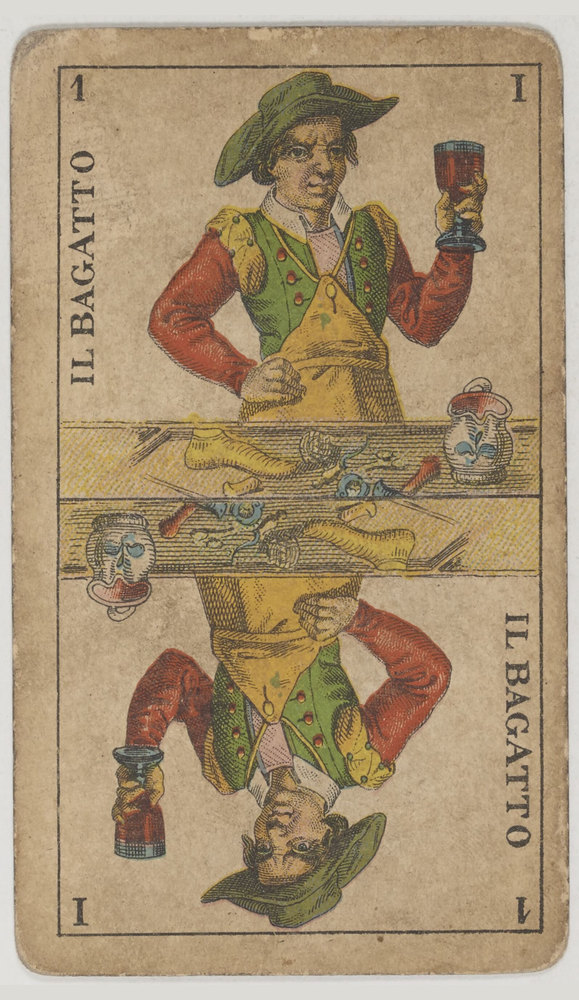
Tarocco Piemontese (Della Rocca, Genoa, 1887)
A Piedmontese tarot printed by Fratelli Armanino in Genoa in 1887, following the pattern Carlo Della Rocca engraved for Gumppenberg in Milan in 1835. Courts and trumps are double-headed, as nineteenth-century Italian playing cards were, and the deck is drawn and lithographed rather than cut in wood — which sets it apart from every other historical deck here. It keeps the Marseille order, where Justice is VIII and Strength is XI, the reverse of Rider-Waite-Smith. Scans from the Bibliothèque nationale de France via Wikimedia Commons, public domain.
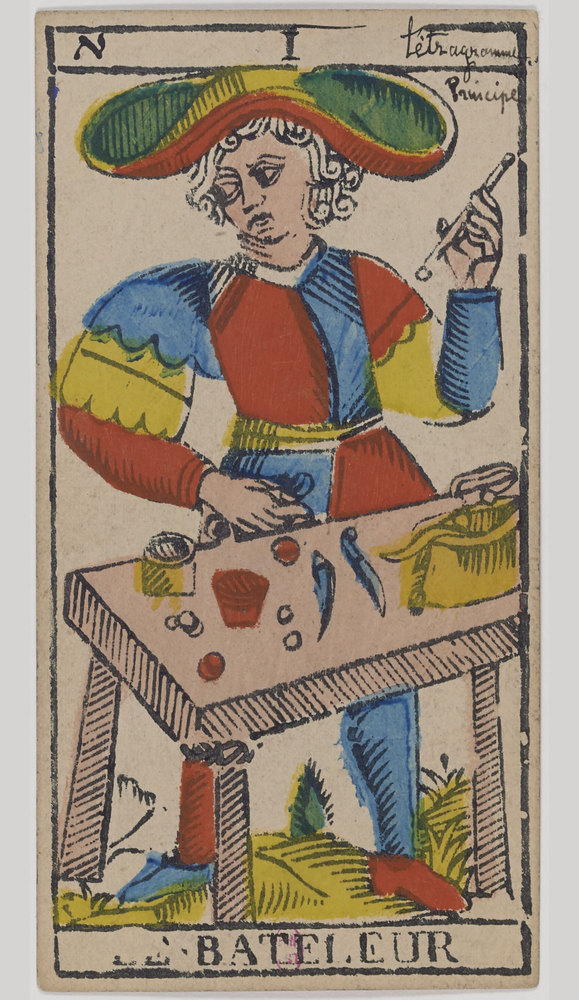
Tarot de Marseille (after Conver, c. 1890)
A Tarot de Marseille printed in France around 1890 from the pattern Nicolas Conver cut in Marseille in 1760 — the Two of Coins still carries his 1760 imprint. Conver's own printing is the pattern most modern Marseille decks descend from, but no complete set of it has been digitised; this later pull from the same model is the closest complete one that is freely available. It keeps the Marseille order, where Justice is VIII and Strength is XI, the reverse of Rider-Waite-Smith. Scans from the Bibliothèque nationale de France via Wikimedia Commons, public domain.
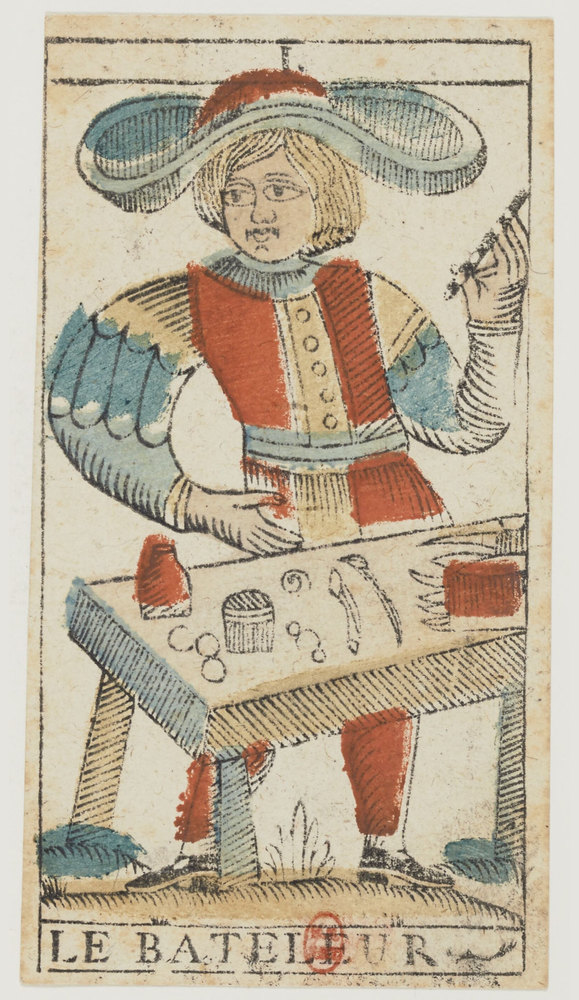
Tarot de Besançon (Schaer, Solothurn, 1784)
A Swiss Besançon tarot from 1784, cut by Bernard Schaer in Solothurn — the Two of Coins carries his name. It is the oldest Besançon here by a century, and the pack survives with its printed paper wrapper, which advertises it as coming from the source of good tarots. Like every Besançon it puts Juno at II and Jupiter at V in place of the Popess and the Pope, and keeps the Marseille order, where Justice is VIII and Strength is XI — the reverse of Rider-Waite-Smith. Scans from the Bibliothèque nationale de France via Wikimedia Commons, public domain.
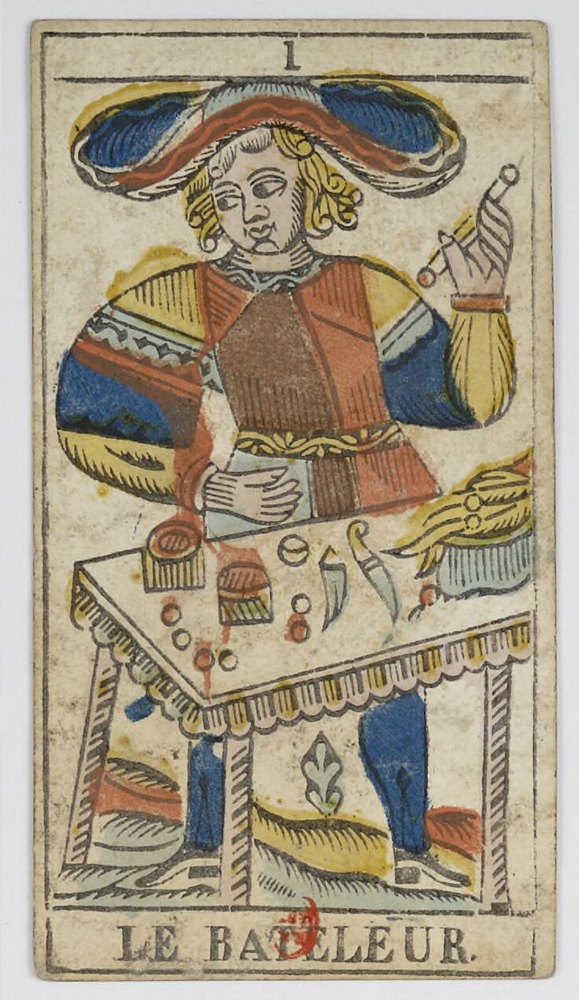
Tarot de Marseille suisse (Gassmann, Geneva, c. 1860)
A Swiss-made Tarot de Marseille from the middle of the nineteenth century, printed by Gassmann, card-maker in Geneva, whose name appears on the Two of Coins. Swiss workshops of this period usually printed the Besançon pattern with Juno and Jupiter; this one keeps the Popess at II and the Pope at V, so it is a true Marseille made in Switzerland. It follows the Marseille order, where Justice is VIII and Strength is XI, the reverse of Rider-Waite-Smith. Scans from the Bibliothèque nationale de France via Wikimedia Commons, public domain.
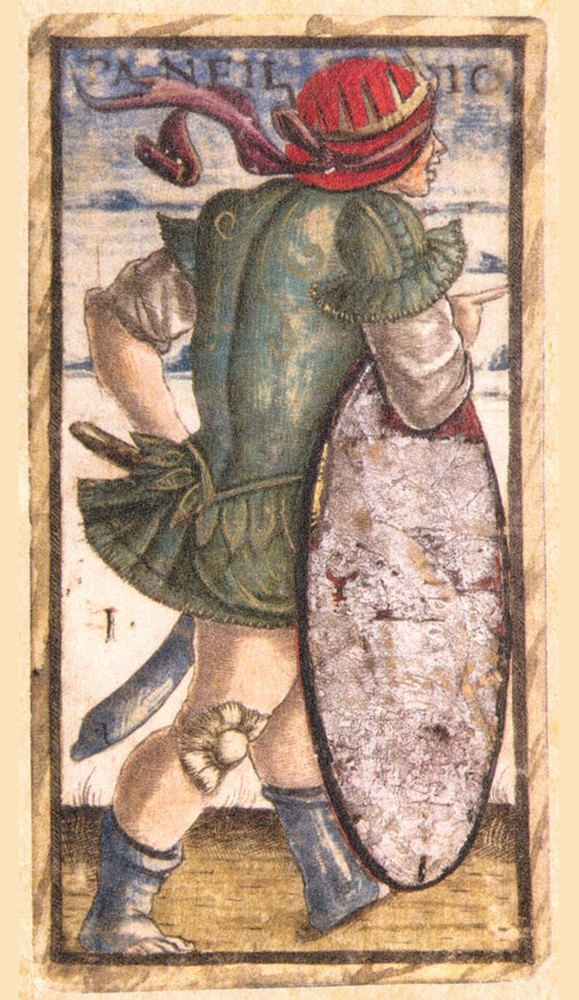
Sola Busca (Italy, 1491)
The oldest complete tarot deck that survives, engraved in northern Italy in 1491, and the only one before Rider-Waite-Smith whose pip cards are pictures rather than arrangements of suit signs — four centuries before Pamela Colman Smith did the same. Its trumps are not the Marseille figures at all but named Romans and Biblical kings, from Mato at O to Nabuchodenasor at XXI. No card back and no box survive, so the back shown here is a modern reconstruction: the deck's own paper colour, ruled in its own ink. Images from Wikimedia Commons, public domain.
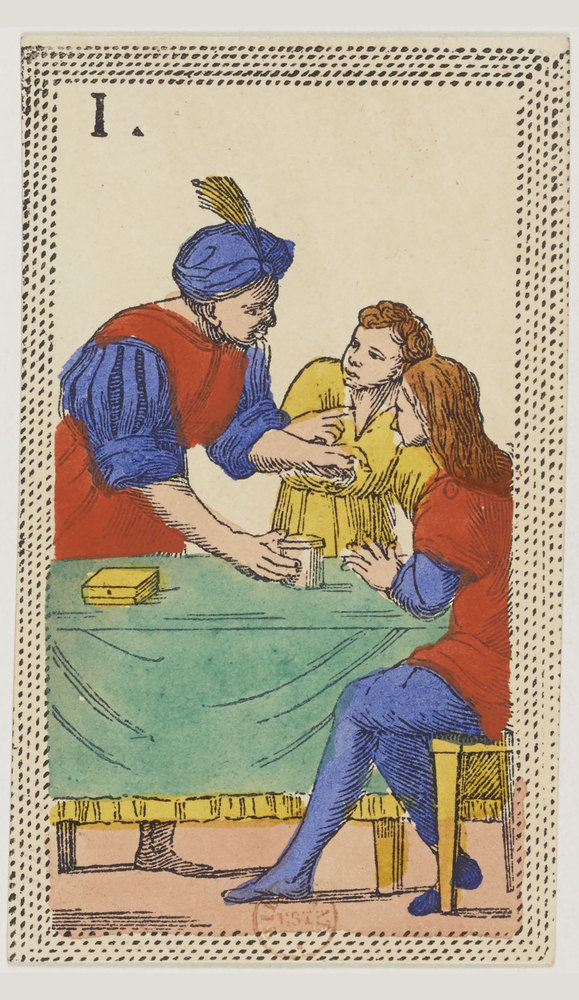
Minchiate (Baragioli, Florence, c. 1870)
A Florentine Minchiate — 97 cards, the largest historical tarot. Forty trumps and the Fool in place of twenty-two, holding the four cardinal and three theological virtues, the four elements and the twelve signs of the zodiac. The top five trumps — Star, Moon, Sun, World and the Trumpets — carry no numeral and rank above everything numbered; the Trumpets is captioned FAMA VOLAT, rumour flies. Printed by A. Baragioli in Florence between 1860 and 1890. Scans from the Bibliothèque nationale de France via Wikimedia Commons, public domain.
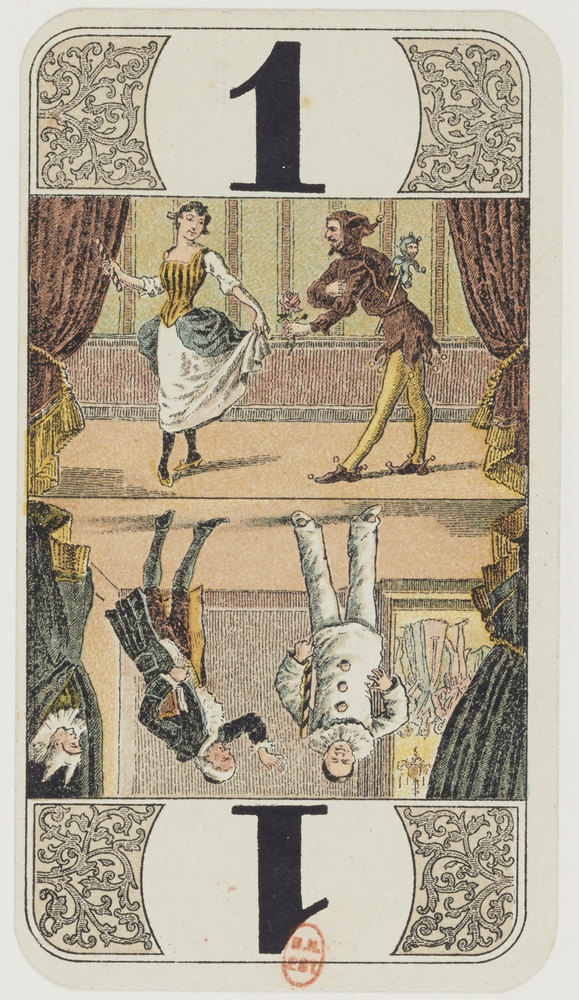
Tarot Nouveau (Grimaud, Paris, 1898)
A playing deck rather than a divinatory one. Twenty-one numbered trumps and the Excuse, with four French suits — hearts, diamonds, clubs and spades — of fourteen cards each. The trumps carry no titles and no occult subjects at all: they are double-headed genre scenes of nineteenth-century life, printed for the game of French tarot, which is still played with this pattern today. Printed by B.-P. Grimaud in 1898. Scans from the Bibliothèque nationale de France via Wikimedia Commons, public domain.
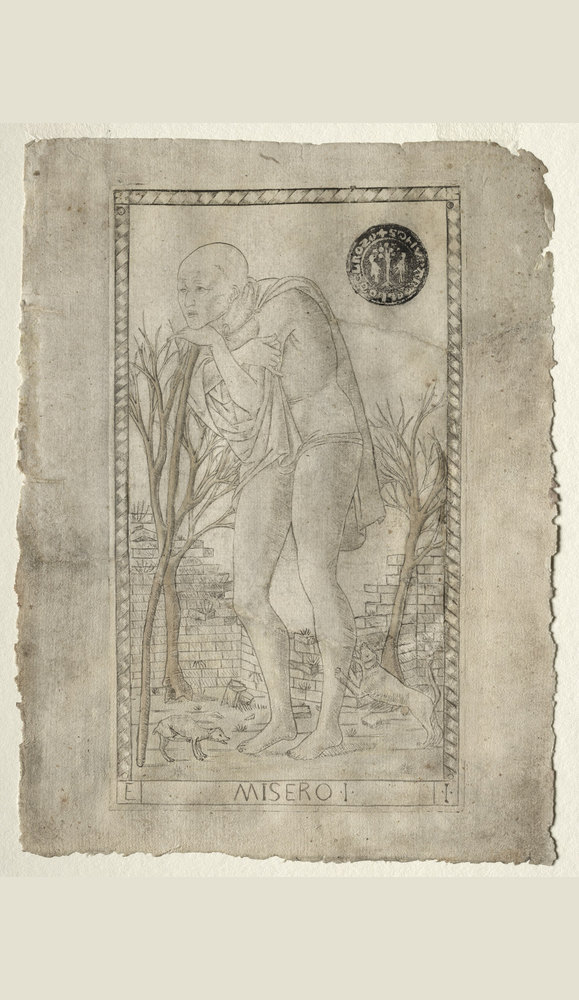
Tarocchi of Mantegna (Ferrara, c. 1465)
Not a deck, and not a tarot. Fifty engravings printed in Ferrara or Venice around 1465 by an anonymous hand known as the Master of the E-Series, who had nothing to do with Mantegna. The sheets were never cut and never played with: they are a teaching ladder of the world, numbered 1 to 50 and divided into five tens — the conditions of man, Apollo and the Muses, the liberal arts, the cosmic principles and virtues, and the firmaments of the universe. There are no suits, no trumps and no court cards. No card back exists either; the one shown here is a modern reconstruction in the sheets' own paper colour. Images from the Cleveland Museum of Art, CC0.
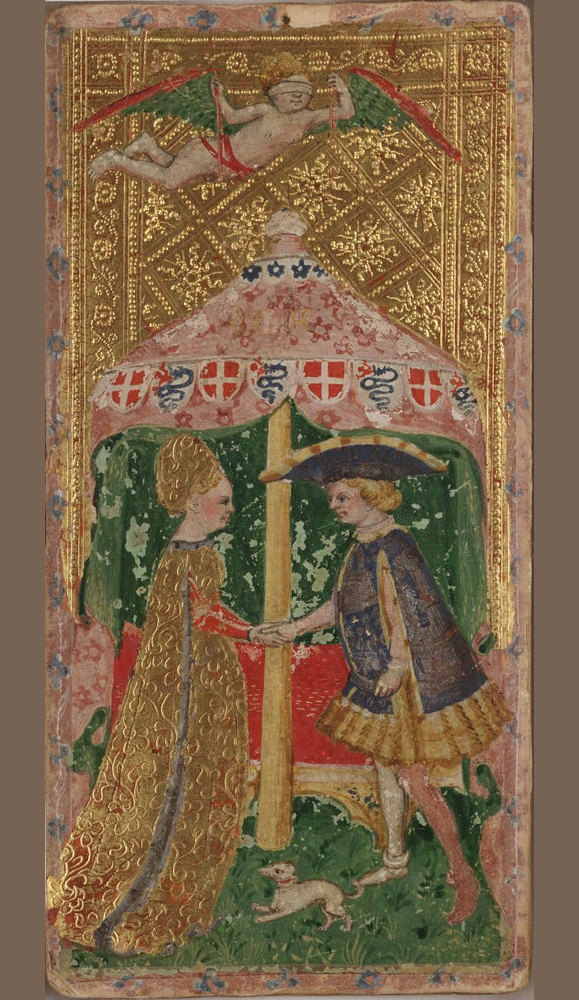
Cary–Yale Visconti (Milan, c. 1442)
One of the oldest surviving tarots, painted on gold in Milan around 1442 for the Visconti court. Sixty-seven cards remain, and no two suits are missing the same ranks. Alone among historical decks it gives every suit six courts — King, Queen, Knight, Horsewoman, Damsel and Knave — and puts Faith, Hope and Charity among its trumps, of which only eleven survive. No card back survives either; the one here is a modern reconstruction in the deck's own tone. Images from the Beinecke Rare Book & Manuscript Library, Yale University, public domain.
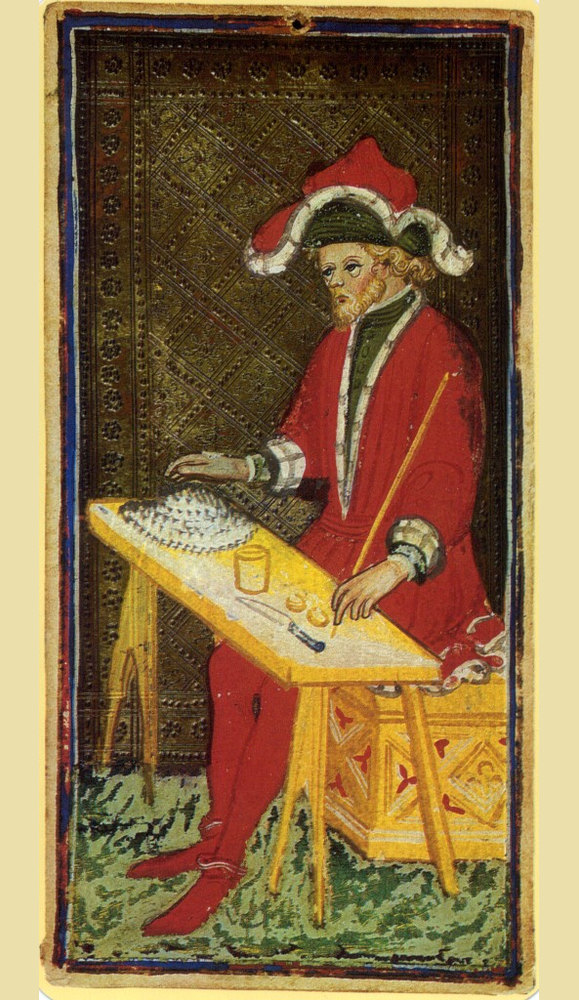
Visconti–Sforza (Milan, c. 1451)
The most famous of the early tarots, painted in Milan around 1451 for Francesco Sforza and Bianca Maria Visconti. Seventy-four of its seventy-eight cards survive, split across three collections: the Devil, the Tower, the Knight of Coins and the Three of Swords were lost centuries ago, and the King of Cups survives but is absent from the published series — so seventy-three are here. No card carries a number or a title; the Marseille order shown is the one scholarship agrees on, not one the cards state. No card back survives either, and the one here is a modern reconstruction. Images from Wikimedia Commons, public domain — they are photographs of a modern facsimile rather than of the cards themselves.
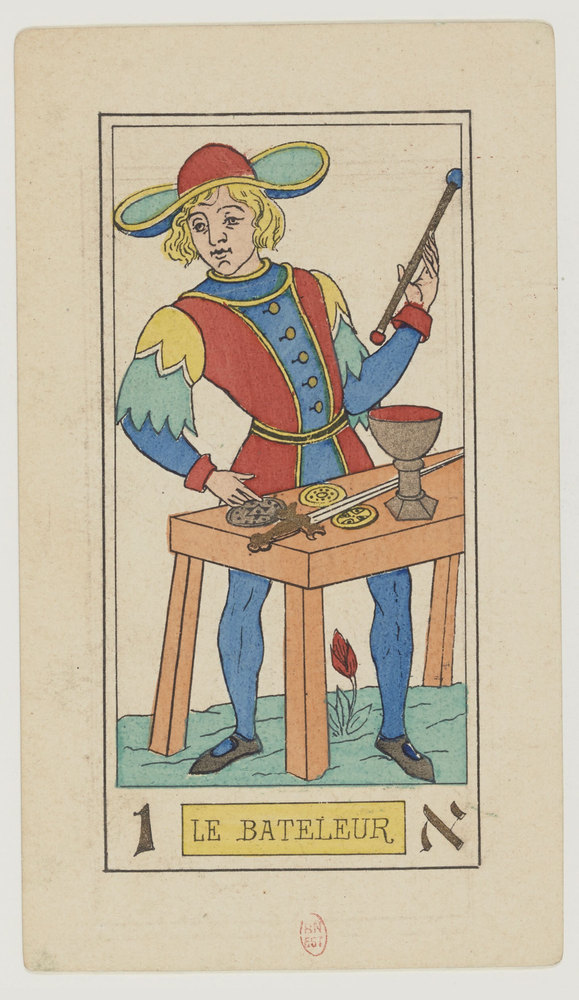
Oswald Wirth (Paris, 1889)
Twenty-two trumps and nothing else — this deck has no minor arcana at all. Oswald Wirth drew it in 1889 for Stanislas de Guaita, and it is the first tarot made deliberately as an occult instrument rather than as a game. Beside each card's number stands a Hebrew letter, the attribution the whole later esoteric tradition rests on. Wirth renames two: his Tower is the Fire of Heaven and his Star is the Stars. Scans from the Bibliothèque nationale de France via Wikimedia Commons, public domain.
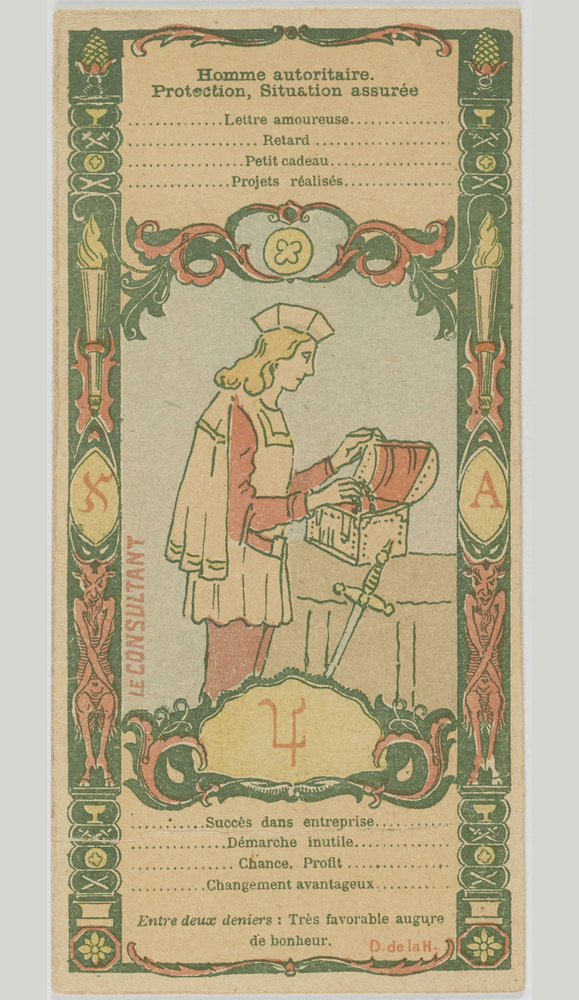
Tarot hiéroglyphique égyptien (Dulora de la Haye, Paris, 1897)
Twenty-two trumps and nothing else, printed in Paris in 1897 by Madame Dulora de la Haye with a twelve-page booklet and a card étui. The cards are large — 161 mm — and each carries its readings printed above and below the picture, so the deck is its own manual. Her names are her own: the Milky Way for the Star, the Will for Judgement, a Shield and a Vase where the Hermit and the Chariot usually stand, and four cards at the head of the sequence that stand for the querent. The order is fixed by the letter of her hieroglyphic alphabet in the cartouche at each card's right edge. Scans from the Bibliothèque nationale de France via Wikimedia Commons, public domain.
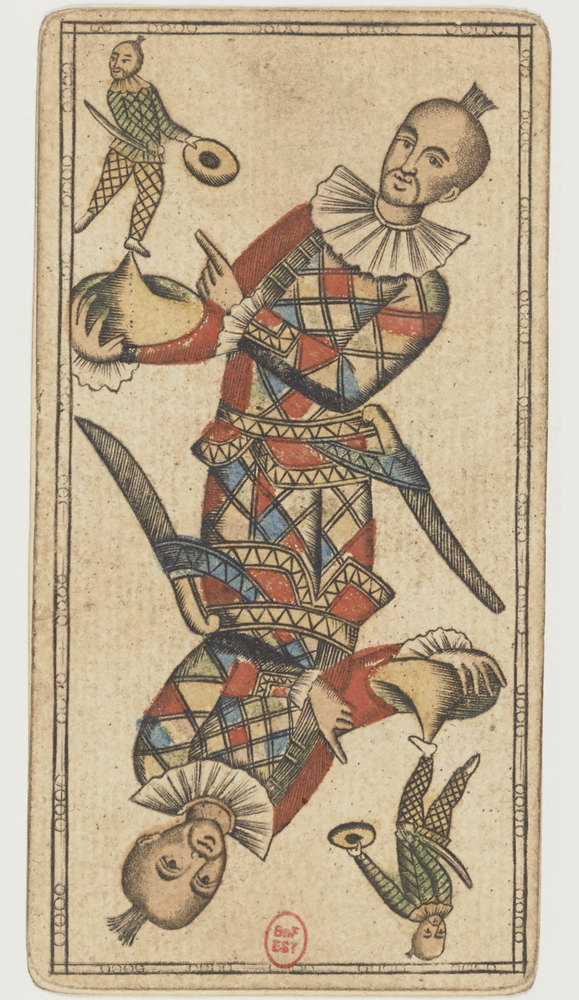
Wiener Tarock (Hoffmann, Vienna, c. 1800)
A Viennese tarock of fifty-four cards, printed by Norbert Hoffmann in Vienna around 1800 — his name is on the Jack of Clubs. It is a game pack, not a divinatory one: the four French suits are stripped to eight cards each, the red suits keeping the low pips and the black the high, and the twenty-one numbered trumps carry chinoiserie scenes above sea-monsters rather than any tarot subject at all. The Sküs, unnumbered, is not a fool standing outside the game but the highest card in it. The BnF calls the pattern "Lemberg". Scans from the Bibliothèque nationale de France via Wikimedia Commons, public domain.
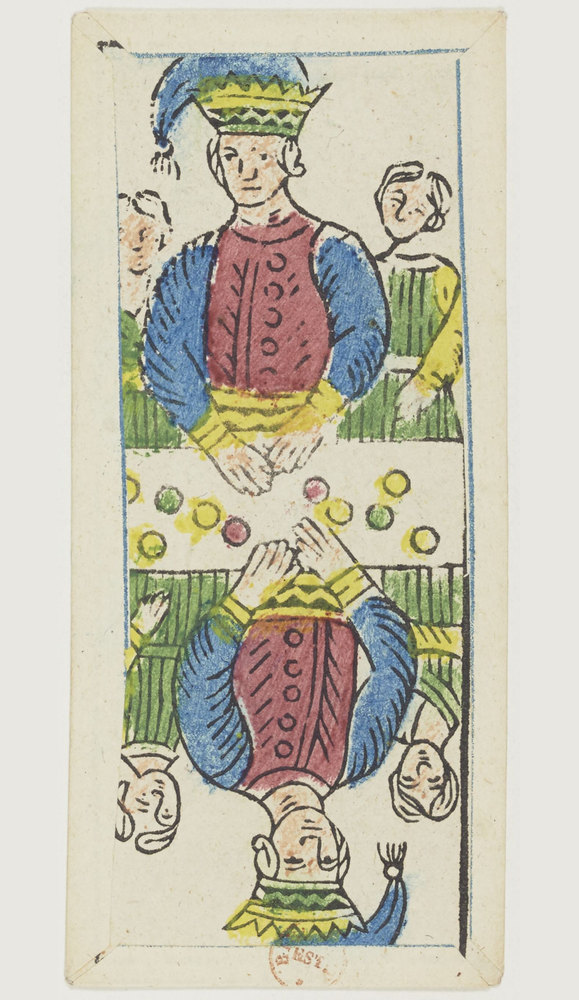
Tarocchino Bolognese (Bologna, c. 1850)
Sixty-two cards: the twos, threes, fours and fives were thrown out of every suit back in the fifteenth century to make the game quicker, and the pack has stayed that way ever since. Four Moors of equal rank stand where an ordinary tarot has the Popess, Empress, Emperor and Pope — they replaced them in 1725. Only trumps 5 to 16 carry a number; the Begato, the Matto and the four highest carry none at all. The cards are double-headed. Scans from the Bibliothèque nationale de France via Wikimedia Commons, public domain.
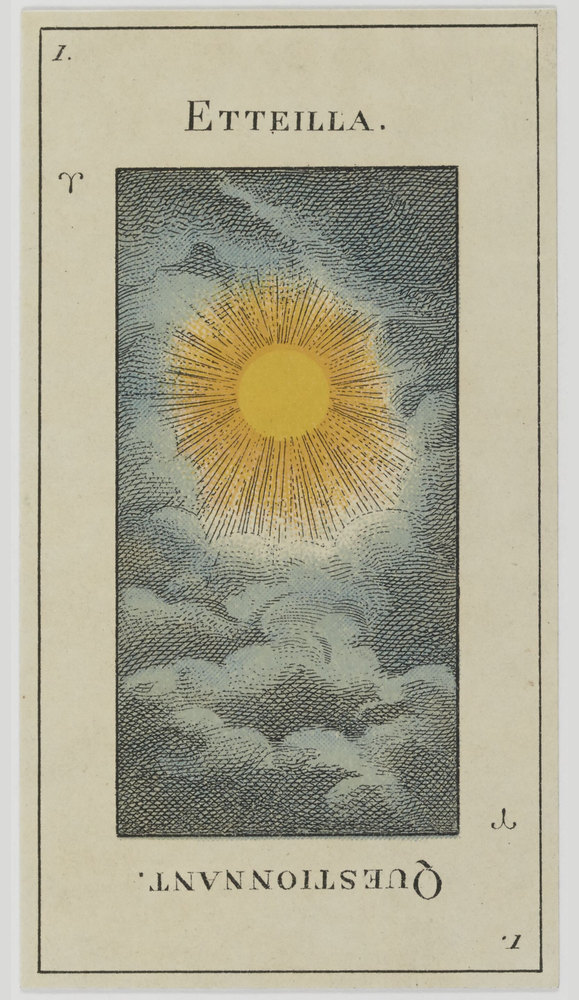
Grand Etteilla (Grimaud, Paris, c. 1890)
The first tarot designed purely for divination, and still the only one where the card is its own interpretation: the upright reading is printed across its head and the reversed reading, upside down, across its foot. All seventy-eight cards are numbered in one run from 1 to 78, and the trumps are not the Marseille subjects at all but Chaos, Light, the Plants, the Sky and the other stages of creation. The deck descends from "Etteilla" — Jean-Baptiste Alliette, a seed merchant who reversed his name in the 1780s and invented this order. Printed by Grimaud in Paris. Scans from the Bibliothèque nationale de France via Wikimedia Commons, public domain.
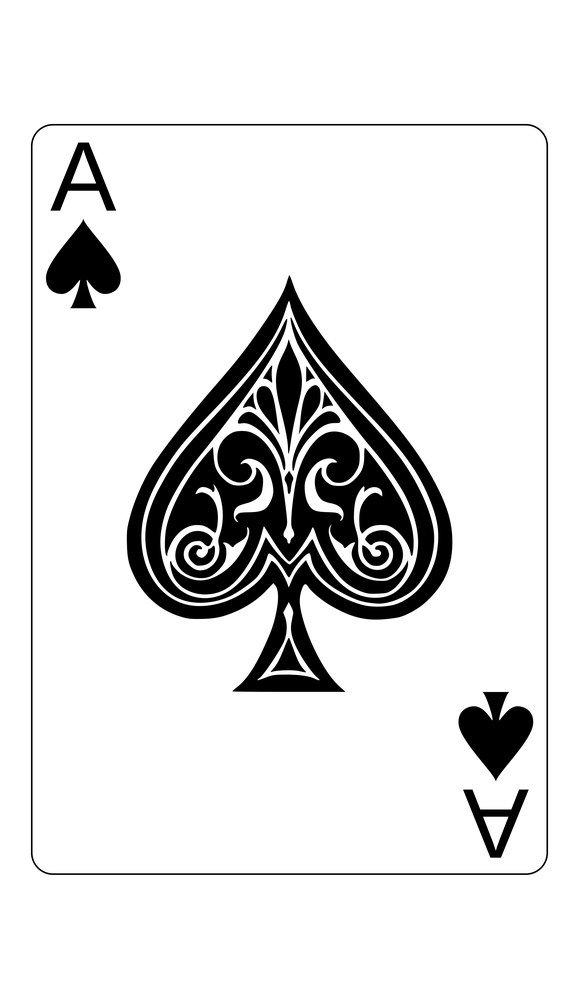
Vector Playing Cards (Byron Knoll)
An ordinary deck: the fifty-two cards of the English pattern that everyone already knows, plus two jokers. Drawn as vector art by Byron Knoll and released to the public domain. It is the only deck here that is not a historical artefact — it is in the collection to be the plain deck the others can be read against. The set carries no card back, so the one shown is a modern reconstruction. Images from Wikimedia Commons, public domain.